Journal of Research Administration
Peer-reviewed and Referred. Scopus and Cosmos Indexed Journal
Peer-reviewed and Referred. Scopus and Cosmos Indexed Journal
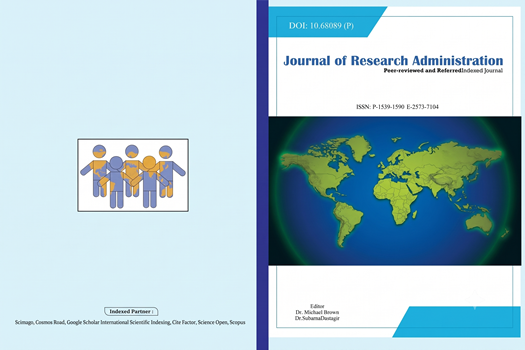
Journal of Research Administration is Peer-reviewed and Referred online journal published in English. The journals have worldwide recognition and fast publication. We provide an intellectual platform for researchers and scholars to set free their unexploited potential. The journal shall assist supervision from prominent and widely read intellects across the globe. Our journals help in providing a favorable, reliable as well as cost-effective solution of processing and delivering the publication to the doorstep of our readers. We believe in the veracity of people with an apparent organizational process. The journals provide for academics, scholars to publish current and significant research as well as publication activities.
Journal at Glance:
Journal of Research Administration
DOI: 10.68089 (P)
Exicutive Editor:
Indexed Partner: Scimago, Cosmos, Road, Google Scholar, International Scientific Indexing, Cite Factor, Science Open, Scopus.
Ms. Muneerah Sehaim Al Otaibi; Prof. Nirvana Abdelrahman Gheith; Prof. Maram Ahmed Bankhar PDF
Background: Incident reporting is a core patient-safety mechanism because it translates frontline errors, adverse events, and near misses into organizational learning. In practice, however, the presence of a reporting system does not guarantee consistent reporting behavior, particularly when reporting remains shaped by fear, confidentiality concerns, weak feedback, and workflow friction. Aim: To examine nurses’ awareness of incident reporting practices, self-perceived reporting practice, and perceived barriers to incident reporting in an accredited Saudi governmental hospital. Methods: A single-site cross-sectional survey was conducted among nurses at Al Quwayiyah General Hospital. Data were collected between January 2024 and January 2026, and the final analytic sample comprised 223 nurses. The questionnaire included demographic and workplace characteristics, awareness of and access to the incident reporting system, self-perceived reporting practices across 11 incident scenarios, perceived obligation to report, and perceived barriers. Descriptive statistics, correlation analysis, and group comparisons were applied. Results: Most participants reported that an incident reporting system existed in their workplace (88.8%) and that they knew how to access the reporting form (81.2%). Although 69.1% had ever completed an incident form, only 38.1% had submitted a report in the last month. The overall awareness score averaged 3.58 ± 1.219. Scenario-based responses showed high recognition of reportable incidents, whereas actual reporting was consistently lower across key events. The mean self-perceived reporting practice score was 3.010 ± 0.3925, and the mean barrier score was 2.876 ± 0.6092. The highest barrier items were lack of coworker support (3.11 ± 1.193), worry about litigation (3.08 ± 1.281), and concern about who might access disclosed information (3.06 ± 1.167). Awareness correlated positively with reporting practice (r = 0.326; p < 0.001), whereas barriers correlated negatively with reporting practice (r = -0.424; p < 0.001). Conclusion: High awareness and system visibility coexisted with lower routine reporting, indicating a clear recognition-reporting gap. Awareness alone appeared insufficient when reporting remained constrained by social, legal, and confidentiality-related barriers. Strengthening non-punitive culture, confidentiality assurance, feedback loops, and workflow support may be necessary to improve consistent reporting behavior.
Omoye Ezie Israel , Ugbeghene Josephine & Zincware Peretonghanbofa PDF
This study examines the effects of quality control management (QCM) on employee performance in selected manufacturing firms in Delta State, Nigeria. Specifically, it investigates how conformance to standard, process adaptiveness, and employee competency, the three key dimensions of QCM, shape workforce performance outcomes. A descriptive survey design was adopted, with primary data gathered from 94 usable responses (87.04% return rate) derived from a target population of 332 employees across five manufacturing firms, using the Taro Yamane sampling formula. A structured, Likert-scale questionnaire with a Cronbach alpha reliability coefficient of 0.763 served as the research instrument. Data were analysed using descriptive statistics and multiple regression via EViews 13.0. Findings establish that conformance to standard (β = 0.1734, p = 0.046), process adaptiveness (p = 0.036), and employee competency (β = 0.0346, p = 0.010) each exert a statistically significant positive effect on employee performance. The model explains approximately 99.85% of variance in employee performance (R² = 0.9985; F = 890.53, p < 0.001). These results underscore the strategic imperative of institutionalising robust quality control practices in manufacturing settings. The study recommends sustained training investment, inclusive quality governance, and dedicated quality control units in Delta State manufacturing firms.
Masakuni Taniguchi; Keisuke Uenishi; Kiminori Gemba PDF
Declining research capabilities at Japanese universities in recent years have highlighted the importance of university research administrators (URAs), especially given that Japanese institutions prioritize university rankings as indicators of their reputation. This study aims to examine the relationship between the number of URAs at Japanese universities and the rankings of those universities. Data on university rankings, number of URAs employed, and several research-related indicators were quantitatively analyzed using multiple regression and correlation analyses. The results show a positive relationship between the number of URAs and the university’s ranking, indicating that universities with a better ranking tend to employ a greater number of URAs. Moreover, the amounts of monetary gifts received, external funds acquired, and research outputs also exhibit positive relationships with university rankings, while the number of URAs and amount of acquired external funds are statistically significant determinants of university rankings. Therefore, increasing the number of URAs can potentially improve both research management and university rankings.
Urhibo Bridget Onajite, Agbamu Mercy Etakpobunor *; Agbawe Ohwologbo Monday, Omiaye Lewis Ajakpovi, Richard Ufuoma PDF
The study investigated time management in balancing career and family responsibilities among female lecturers at Delta State University, Abraka. Three research questions were asked in line with the objectives, leading to the formulation of three hypotheses. The design adopted was the descriptive survey. The population comprised 196 female lecturers across 15 faculties of Delta State University, Abraka, and all were used as the sample in a census approach. The instrument for the study was a structured questionnaire divided into Sections A and B; Section A addressed the demographic characteristics of respondents, while Section B focused on thematic questions related to the study variables. The instrument was validated and tested, achieving a Cronbach alpha reliability coefficient of 0.86. The questionnaire was administered to all 196 respondents, out of which 162 were properly completed and used for analysis. The findings, obtained through multiple regression analysis, showed that tasks planning significantly influenced balancing career and family responsibilities (β = 0.550, p = 0.000), while duties prioritization also had a significant effect (β = 0.524, p = 0.000). Time monitoring, however, had a positive but insignificant effect (β = 0.053, p = 0.358). The study further revealed that female lecturers aged 36–45 years and those in lower and middle academic ranks were more engaged in balancing professional and family roles. The study concluded that structured planning and prioritization are critical for achieving work–family balance and recommended that both individual lecturers and institutions adopt strategies to enhance these time management practices.
Abdon Ribeiro da Silva Neto; Valmir Batista Prestes de Souza PDF
Context: This study addresses the following research question: How does the scientific literature characterize the manifestations of New Public Management within the Brazilian Judiciary, with particular regard to its principles, practices, and management instruments? Objectives: Its general objective is to identify and analyze, through an integrative literature review, the manifestations of New Public Management (NPM) in the Brazilian Judiciary. The specific objectives are to identify and characterize the scientific production addressing NPM in the context of the Brazilian Judiciary; to examine the principles and features of NPM reflected in judicial management practices as reported in the literature; to map the management mechanisms, practices, and instruments associated with efficiency, performance, productivity, and results-based management; to classify the theoretical and methodological approaches adopted in the selected studies; and to identify gaps in the existing body of knowledge while indicating avenues for future research on NPM in the Brazilian Judiciary. Research methodology: Based on secondary sources and a structured bibliographic survey, the study draws on data retrieved from the CAPES Journals Portal, accessed through the Federated Academic Community (CAFe), as well as from Google Scholar. The final sample comprised eight scientific studies, enabling a systematic analysis of the subject. Results: The findings reveal at least three recurring themes across the reviewed studies: (i) NPM is not portrayed as a single or homogeneous model implemented throughout the Brazilian Judiciary; (ii) high levels of formal governance indicators do not necessarily correspond to higher levels of institutional performance; and (iii) NPM mechanisms—such as targets, performance indicators, and results-based management—coexist with mechanisms associated with New Public Governance. Conclusions: The study concludes that NPM does not constitute an uniform or homogeneous model; rather, it is manifested through a set of principles and management instruments that have been progressively and unevenly incorporated into judicial management structures and practices.
Open Access Journal | Steps Of Publication | Journal Editorial Board | Journal Indexing | Paper Publication Charge



 MENU
MENU